
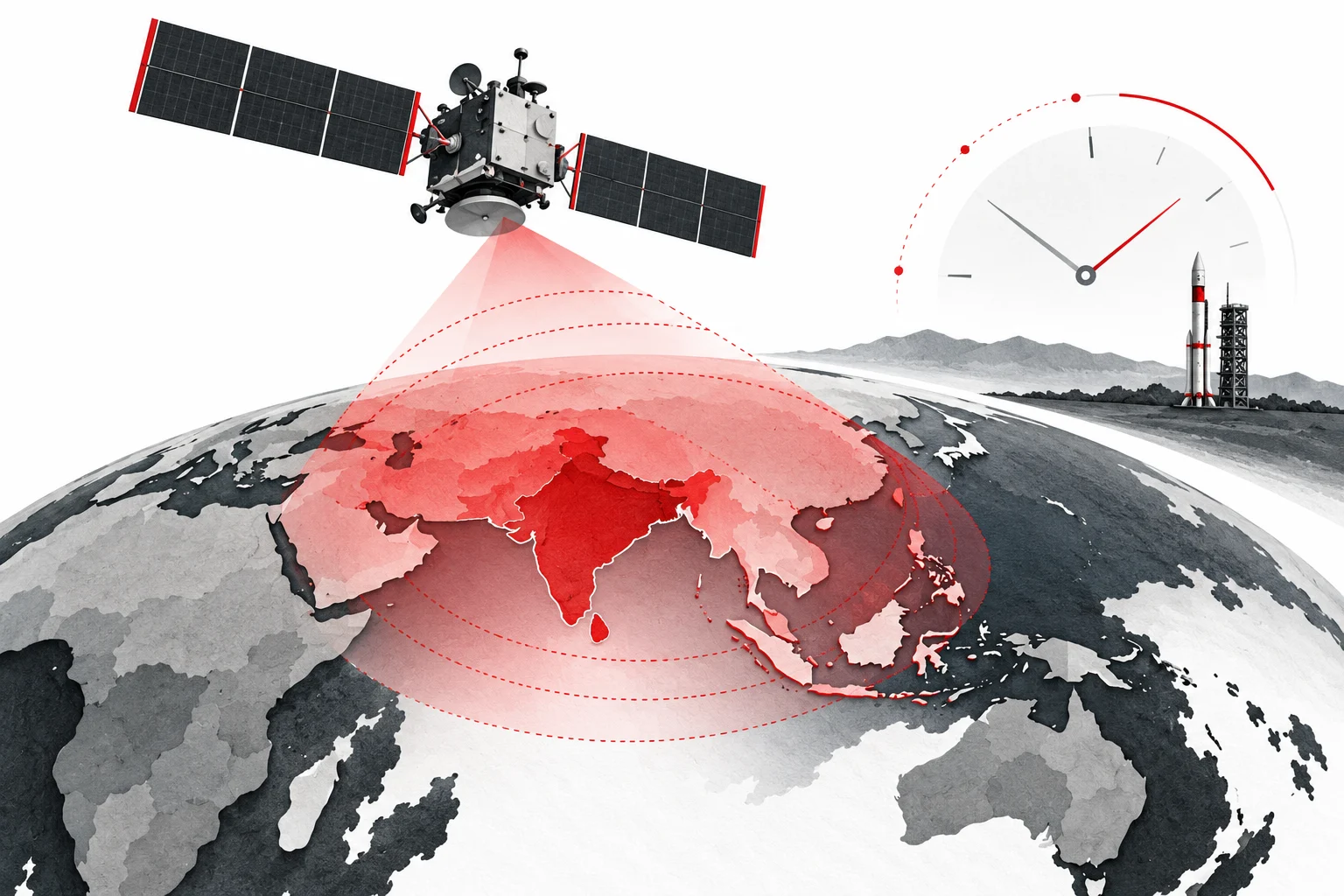
BENGALURU, October 29 — The Indian Space Research Organisation is preparing to launch the NVS-03 navigation satellite aboard GSLV-F18 from Sriharikota on October 30. The mission is intended to strengthen continuity of India’s regional satellite-navigation services, with an indigenous atomic clock among its important onboard systems.
ISRO’s October 28 mission page confirms the spacecraft, launch vehicle and planned injection into a geosynchronous transfer orbit. The announced launch date is a target, rather than evidence that the satellite has already reached its operational orbit or begun providing navigation signals to users.
What ISRO has confirmed
GSLV-F18 will be the twentieth flight of India’s Geosynchronous Satellite Launch Vehicle. ISRO identifies the second launch pad at the Satish Dhawan Space Centre as the departure point.
NVS-03 is the third spacecraft in the next-generation navigation series intended to maintain continuity for the earlier Indian Regional Navigation Satellite System. The system is now known as Navigation with Indian Constellation, or NavIC.
The mission page says the spacecraft carries an Indian-developed atomic clock alongside procured clocks. It also includes an L1 navigation signal in addition to the existing L5 and S-band signals. ISRO describes the service region as India and an area extending approximately 1,500 kilometres around its boundary.
Why navigation satellites need precise clocks
Satellite-navigation receivers work with accurately timed signals to determine position. Timing therefore forms part of the service infrastructure, rather than serving merely as an onboard convenience.
An indigenous clock contributes to domestic capability in a demanding component of navigation technology. However, carrying such a clock is a design feature; its performance over the mission’s life must be established through operation and testing.
The new satellite should also be understood as part of a system. Ground monitoring, signal quality and compatible user equipment all matter. A spacecraft announcement does not automatically demonstrate a particular accuracy improvement for every phone, vehicle or navigation receiver.
The significance of the L1 signal
ISRO’s navigation-services documentation describes L1 as an additional civilian signal interoperable with other global navigation systems. The agency has also announced work with Qualcomm on selected platforms supporting NavIC L1.
That provides a route towards broader use in mobile, automotive and connected-device applications. It does not mean that every existing handset gains NavIC capability after this launch. Hardware, receiver support and product implementation remain relevant.
The mission’s civilian significance therefore extends beyond getting another satellite into orbit. Adoption requires a functioning signal and a user ecosystem able to receive and use it. The official documentation establishes the direction of that effort, rather than a universal consumer rollout date.
Lessons from NVS-02
The preceding NVS-02 mission illustrates why the distinction between launch success and spacecraft readiness matters. ISRO’s February 2026 review says that NVS-02 reached its intended elliptical transfer orbit after launch on January 29, 2025, but could not complete orbit-raising operations.
The review identified the failure of a drive signal to reach a propulsion-system pyro valve. Its committee considered disengaged connector contacts in the main and redundant paths the most likely cause.
ISRO said the committee recommended measures to improve redundancy and reliability. It also reported satisfactory performance of corrective actions on the CMS-03 spacecraft and said applicable recommendations would guide future missions.
These findings explain the engineering context for the upcoming flight. They do not guarantee NVS-03’s outcome, and the available official mission page does not provide a complete public qualification record for every spacecraft subsystem.
Launch is only the first milestone
GSLV-F18 is intended to place NVS-03 into a transfer orbit. The spacecraft must then complete the operations necessary to reach its intended working orbit, followed by checks before a navigation-service outcome can be established.
Reporting the rocket’s liftoff as a completed restoration of navigation capability would skip those stages. Relevant updates will include orbital status, spacecraft health, payload testing and confirmation of operational service.
The same caution applies to launch schedules. A targeted departure can change if weather or technical conditions require a hold. Readers planning to follow the mission should use ISRO’s latest announcements rather than assume an earlier reported time remains final.
What NavIC is designed to provide
ISRO describes NavIC as a regional positioning, navigation and timing system with civilian and restricted services. Its applications include transport, surveying, location-based services and time synchronisation.
The regional focus distinguishes it from systems designed for worldwide coverage. ISRO’s documentation also describes interoperability with other navigation systems, allowing suitable receivers to combine signals.
For India, maintaining domestic navigation infrastructure has practical value for services that depend on reliable position and timing. Measuring that value requires sustained system performance and actual use, rather than treating the launch announcement alone as the final achievement.
What to watch next
The immediate development is the planned October 30 flight and the payload configuration confirmed by ISRO. At the time of the source material reviewed here, launch and commissioning remained prospective.
A successful flight would mark progress in renewing the constellation. Confirmation of navigation service would require subsequent evidence from the agency. Keeping those milestones separate provides a clearer measure of what the mission accomplishes and what remains to be demonstrated.